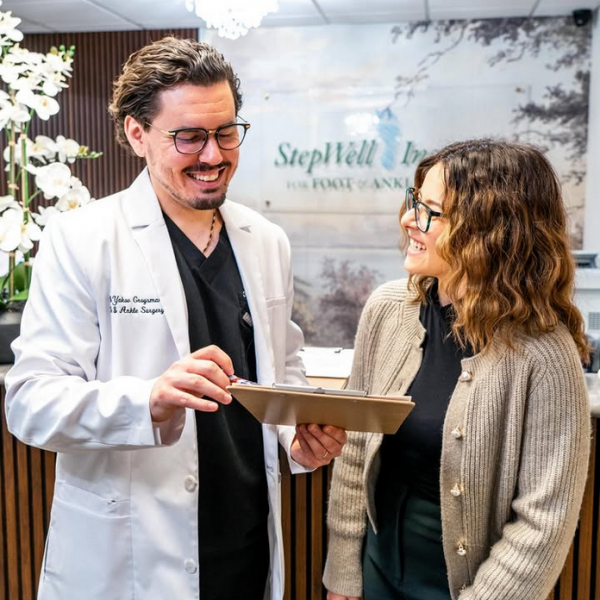
Find out if you're a candidate for minimally invasive bunion correction.
Answer 5 quick questions about your bunion. We'll tell you — based on your symptoms, severity, and goals — whether you're a strong candidate for MIS, whether to keep monitoring, or whether a different procedure makes more sense.
Just the closest match — we'll get more detail at consult.
When are you hoping to address it?
No commitment — just so we can plan with you.
Want a personalized assessment?
Optional — leave your info and we'll review your answers, share next steps, and reserve a consult slot for you.
Strong candidate
Based on your answers, you're likely a candidate for MIS.
Most patients with your profile do well with minimally invasive correction. The next step is a free 30-minute consult — we'll take a weight-bearing X-ray, confirm the angle, and walk you through exactly what your procedure and recovery would look like.
Recommended next steps
Book a free 30-min consult — bring any prior X-rays
We verify your insurance before scheduling — no surprise bills
If you're a candidate, most patients schedule within 2–3 weeks
A bunion forms when the big toe drifts toward the second toe and the first metatarsal shifts outward — creating that painful bony prominence on the side of the foot. Left alone, the angle keeps drifting at roughly 1–2° per year.
01
The bony prominence
That visible "bump" isn't extra bone — it's the head of the metatarsal pushing outward as the joint deforms.
02
Big toe drift
The hallux (big toe) angles toward the second toe. Over time it can overlap or push it out of position entirely.
03
Joint stress and pain
The mis-aligned joint takes the brunt of every step. Pain, redness, calluses, and limited shoe choices all follow.
Why minimally invasive
Same correction. Much smaller footprint.
Minimally invasive bunion surgery uses incisions just a few millimeters wide and live X-ray (fluoroscopic) guidance to realign the bone — then stabilizes it with small internal screws. The structural result matches open surgery, but the recovery looks nothing like it.
01
Tiny incisions
A few millimeter-sized openings instead of one long incision means dramatically less soft-tissue disruption and faster healing.
02
Less pain and swelling
Because the surrounding muscle and ligaments are barely touched, postoperative pain and swelling are substantially lower than traditional open bunionectomy.
03
Walk the same day
Most patients leave in a protective surgical shoe — weight-bearing immediately. No cast, no non-weight-bearing period, no crutches.
04
Faster return to shoes
Patients typically return to sneakers in 3–4 weeks and to dress shoes around 6–8 weeks — versus 3–4 months with traditional open surgery.
05
Cosmetically better
The scars from millimeter incisions usually fade to nearly invisible by month 6. Many patients find they no longer hide their feet.
06
In-office, local anesthesia
The procedure is done in our Manalapan office under local anesthesia — no hospital stay, no general anesthesia, no driver required.
MIS vs. traditional surgery
Two paths to the same correction. The recovery is what's different.
Open bunionectomy still has a place — for severe deformities and complex revisions. But for the majority of bunions, minimally invasive surgery delivers an equivalent structural result with substantially less downtime.
Traditional open bunionectomy
Pre-2010 standard of care
3–4 inch incision along the side of the foot
Hardware: 1–2 metal screws, sometimes plates
Plaster cast or boot for 6–8 weeks, non-weight-bearing
Typical return to dress shoes: 3–4 months
Visible scar, often pigmented
Minimally invasive bunion correction
What we do · in-office
Several millimeter-sized incisions instead of one long cut
Small internal screws hold the realignment; no cast required
Live fluoroscopic (X-ray) guidance throughout
Walking boot, weight-bearing same day
Return to sneakers in 3–4 weeks · scar nearly invisible by month 6
Meet your surgeon
Dr. Yakov Groysman, DPM
Foot & Ankle Surgeon · Founder, StepWell Institute
Dr. Groysman has performed more than 500 bunion procedures since 2008, including over 1,400 using minimally invasive techniques. He trained in advanced reconstruction at the New York College of Podiatric Medicine and completed his surgical residency at the Hoboken University Medical Center.
His practice is built around a simple idea: bunion correction should be done in a way that respects the rest of your life. That means tiny incisions, same-day walking, and honest answers about what the procedure can and can't do for you.
ABFAS
Board-certified, American Board of Foot & Ankle Surgery
2008
Performing bunion correction since
500+
Bunion procedures performed
The procedure in four steps
From check-in to walking out — about 90 minutes.
Performed in our Manalapan office under local anesthesia. No general anesthesia, no overnight stay, no driver required.
Step 01
Imaging & plan
15 min
Fresh weight-bearing X-ray. You see the exact correction angle traced on your image before we start.
Step 02
Local anesthesia
10 min
Targeted ankle block numbs the foot. You stay awake, comfortable, and chatty throughout.
Step 03
Bone realignment
35–45 min
Through millimeter incisions, specialized instruments under live X-ray reshape and reposition the metatarsal — secured with small internal screws.
Step 04
Walking boot & discharge
15 min
One small bandage, a surgical shoe, and you walk out. Follow-up at day 7 to confirm alignment is holding.
The ones below cover ~80% of what new patients ask. There are more on the full FAQ page.
How does minimally invasive bunion surgery actually work?
Incisions just a few millimeters wide and specialized rotary instruments under live X-ray (fluoroscopic) guidance cut and realign the metatarsal bone. The correction is stabilized with small internal titanium screws. Because the soft tissues are barely disturbed, swelling, pain, and scarring are dramatically lower than with traditional open surgery.
Will my insurance cover this?
If your bunion is medically necessary (causing pain, limiting activity, or progressively worsening), the answer is almost always yes. We run a free benefits check before scheduling so you'll know your exact out-of-pocket up front.
How long is the actual recovery?
Day 1–3: mild ache that responds to over-the-counter ibuprofen for most patients. Week 1: back to office or remote work. Week 4: regular sneakers. Week 6–8: dress shoes and full exercise.
Is there permanent metal in my foot?
Yes. The MIS technique uses small medical-grade titanium screws to hold the realignment while the bone heals. They're typically left in place permanently, don't set off airport scanners, and cause no day-to-day issues for the vast majority of patients.
Can both feet be done at once?
Yes — bilateral procedures take about 75 minutes total and recovery is similar to single-foot. Most patients walk out the same day. Some prefer to do one foot at a time, 2–4 weeks apart, so they always have a "good" foot. We'll talk through what fits your life.
Am I a candidate if my bunion is severe?
In most cases, yes. MIS can treat mild, moderate, and many severe bunions. A small percentage of cases — those with significant joint arthritis or a very wide intermetatarsal angle — are better served by an open technique. We'll tell you honestly which one applies to your foot, before you leave the consult.
Dr Groysman is an extremely knowledgeable, patient, very thorough and truly cares about treating your condition effectively. I greatly admire the time that he takes to properly decide what treatment he feels is best for you and after reviewing the test results he ordered for you.
5/5
Andrew Tantuccio
Dr. Groysman was professional, patient, and very knowledgeable on everything regarding the foot/ankle, and more. I couldn’t have asked for a better outcome as it pertains to my treatment. I’d recommend him to anyone for their podiatry needs as he is one of the best Doctors I’ve been treated by, as well as being an overall fantastic person.
5/5
Laura Longo
Dr. Groysman has been amazing with my 9-year-old son. He was so patient, gentle, and explained everything in a way that made my son feel comfortable and not scared. As a parent, I really appreciated how thorough he was and how he took the time to answer all of my questions. The staff was also very kind and welcoming.
5/5
Lisa Delano
Dr. Groysman was very thorough, extremely knowledgeable and walked through the entire process of what my upcoming surgery will be. Excellent bedside manner and answered every one of my questions and took his time. Beautiful office setting and a very nice staff.
5/5
KyunHee Wong
Dr. Groysman provides efficient and honest evaluation. He is friendly and caring toward his patients and encouraged me to ask him as many questions as I have. I am fully satisfied and grateful to find him and can always rely on him and refer my friends and family to him. He is a gem. Thank you, Dr. Groysman!
5/5
Maria Rodriguez
I had been postponing surgery for eight years because I could not afford the recovery time. Walked out the same afternoon. Back at my desk in five days. The procedure itself was easier than my last dental cleaning.
5/5
Free 30-minute consult
Take The First Step.
Meet Dr. Groysman, see your foot on his screen, and walk out with a clear answer about whether you need surgery, when, and what it'll cost. No pressure, no follow-up sales calls.